
Key Takeaways
- A fact finder's value extends beyond the data it collects; much of it comes from whether that data feeds into downstream portfolio analysis and proposal workflows without manual re-entry.
- Templates can capture analytically useful details like account registration, cost basis, and held-away assets, not just top-line balances.
- For high-net-worth and multi-entity households, a fact finder can be structured to capture ownership relationships between entities, supporting a consolidated household balance sheet.
- Firmwide governance of fact finder templates often involves balancing consistency for compliance and reporting with the flexibility advisors need in discovery conversations.
- One practical objective is a repeatable acquisition workflow where structured intake data can flow into portfolio consolidation, risk assessment, fee analysis, and client-ready deliverables.
Consider an illustrative scenario: an advisor finishes a promising prospect meeting with a completed fact finder. Income, assets, liabilities, and goals are all documented. The next step, however, is administrative rather than analytical. The advisor spends the next several hours manually re-entering that same data into a planning tool, a separate analytics platform, and a proposal template. The fact finder does its job as a form, but it creates little analytical momentum, and the process slows before any analysis begins.
This disconnect is a common source of friction in advisory firms. Many firms have a financial planning fact finder template , but it is often designed as a compliance artifact or a biographical intake form, not as the first step in a repeatable acquisition workflow.
A fact finder's usefulness is closely tied to what it feeds into. Its purpose is not just to collect information but to structure it in a way that shortens the path from raw prospect data to objective portfolio insights. This article is a practical guide for advisors and firm leaders who want to rethink fact finder design not just what sections to include, but how the captured data connects to downstream analysis, proposals, and client-ready deliverables.
This article is for informational purposes only and does not constitute investment, legal, tax, or compliance advice. Your firm may wish to consult with its own professional advisors to determine the appropriate course of action for its specific circumstances.
Core Sections a Financial Planning Fact Finder Template Can Cover
A well-structured fact finder moves beyond a simple checklist by capturing the specific data points that create analytical value downstream. Beyond the standard categories, the difference between a basic template and an analytically useful one often lies in the details.
Most templates cover personal information, income sources, assets, liabilities, insurance coverage, estate planning basics, and financial goals. The opportunity for differentiation is in the specificity within each. For example, when documenting assets, a template that captures 'Brokerage Account $500K' provides a balance, but little else. An analytically useful template would capture:
- Account Registration: Is it individual, joint, trust-owned, or a qualified retirement account like a 401(k) or IRA? This distinction can affect how the account is evaluated within the broader household structure.
- Custodian: Where are the assets held? This informs potential consolidation and transfer workflows.
- Cost Basis: When available, cost-basis information can help inform transition analysis.
- Concentrated Positions: Are there any single-stock or sector concentrations that represent a significant portion of the account?
Similarly, for liabilities, capturing not just balances but also interest rates, terms, and maturity dates provides a much clearer picture of the household's cash flow and balance sheet structure. For insurance, details like annuity surrender schedules and current beneficiary designations can be operationally important. The order in which these sections are presented is another design consideration; some firms lead with goals and concerns before asking for a detailed inventory of accounts, so the prospect understands the purpose of the detail being requested.
Pre-built templates available in many planning and data-gathering tools offer a useful starting point. Beyond the template itself, a related design question is whether the captured data connects to the firm's analytical and proposal workflow. When fact finder data sits in a format that cannot flow into portfolio analysis or proposal generation, advisory firms can absorb significant time in manual re-entry for each prospect.
Read more: How to Create Winning Proposals: 3 Tips for Advisors | VRGL
Adapting Fact Finder Templates for Multi-Entity and High-Net-Worth Households
Some standard fact finder templates are designed primarily around individual or household-level information and may not fully capture more complex entity structures.
Consider an illustrative household with personal brokerage accounts, an irrevocable trust for heirs, a family LLC holding real estate, and a donor-advised fund. A standard client fact finder template might capture these as disconnected line items. This approach gives limited treatment to the context of ownership and control. The distinction between account-level data and entity-level data is a common structural gap in fact finder templates. Capturing a brokerage account balance is not the same as capturing the trust or LLC that owns it, and downstream portfolio analysis may benefit from both layers when building a more complete household-level view.
For advisors serving HNW and ultra-high-net-worth (UHNW) clients, firms may want their intake process to support a consolidated view of the household balance sheet and relevant entity relationships. This involves designing the intake process to map relationships between entities, not just list them. Key considerations include:
- Ownership Structures: Capturing how assets are titled across trusts, partnerships, and personal accounts.
- Cross-Entity Liabilities: Documenting loans or obligations that connect different parts of the balance sheet.
- Income and Cash Flow Dependencies: Understanding how cash moves between operating businesses, investment portfolios, and personal accounts.
- Held-Away Assets: Systematically inventorying held-away assets to build a complete picture of the household-level AUM and allocation.
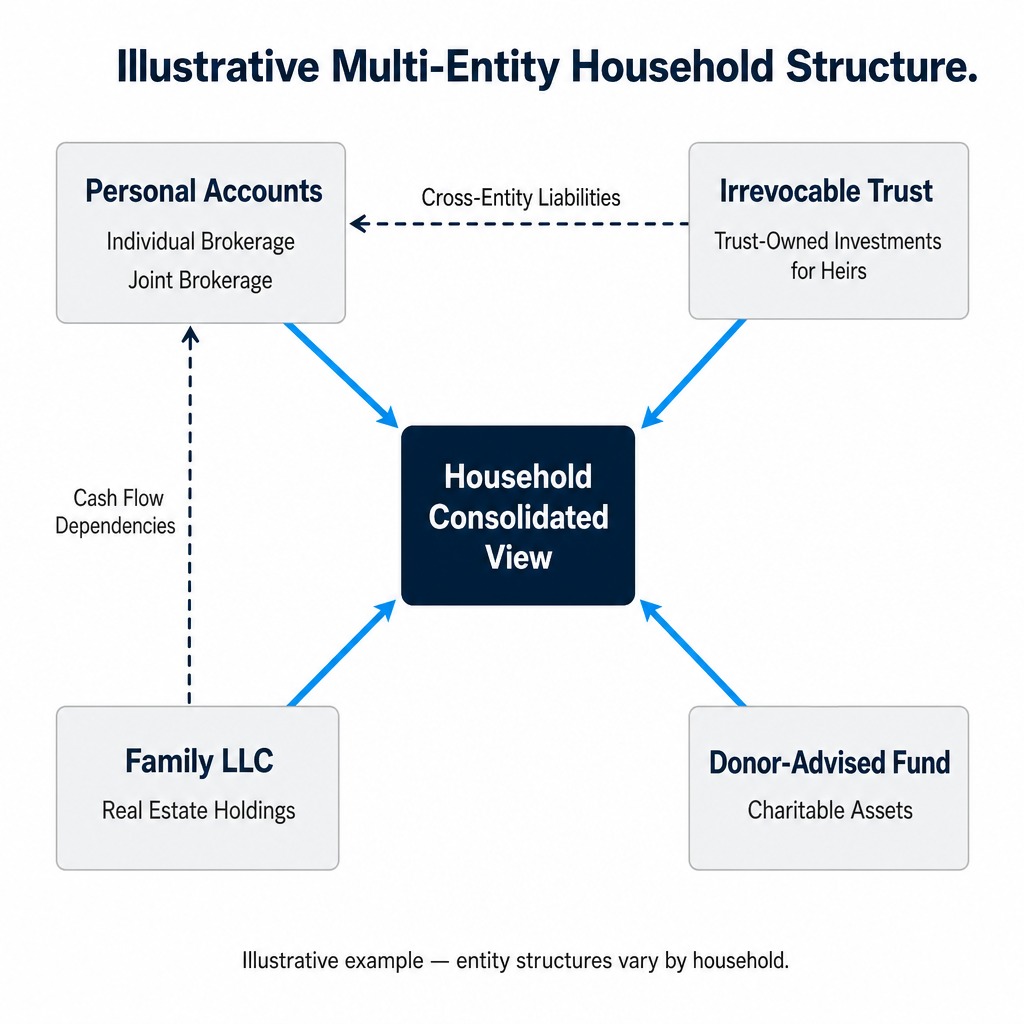
The objective is not just to add more fields to the wealth management fact finder
. It is to structure the data intake in a way that allows the advisor to build a consolidated view of the household's true financial position, which is an important foundation for meaningful portfolio analysis.
Digital and Paper-Based Fact Finders: Integration Considerations
The debate over digital versus paper-based fact finders can overlook a related question: does the captured data flow into the firm's other systems, or does it create a manual data-entry bottleneck? From an operational perspective, integration can matter as much as format.
- Paper-Based Questionnaires: These are familiar to clients and easy to distribute. However, they can require advisors or support staff to manually transcribe information into a CRM or financial planning software. This step can introduce data entry errors and take up staff time.
- Digital Fact Finders: Solutions from dedicated data-gathering providers or features embedded within CRM platforms can streamline data collection. A prospect can fill out the form online, and the data can automatically populate fields in the CRM.
However, a digital form is not inherently more efficient if it is not properly integrated with downstream analytical tools. If a digital fact finder syncs with the CRM but fails to enforce field-level data validation, the data may arrive in a format that planning or analytics software cannot consume without manual cleanup. One useful lens for evaluating a fact finder is how much manual cleanup and re-entry it leaves for the team downstream.
Governance Considerations for Firmwide Fact Finder Templates
Without centralized governance, firms may end up with multiple versions of a financial advisor fact finder as advisors adapt templates to their individual workflows.
Consider an illustrative RIA with twelve advisors that discovered its fact finder template had fragmented into five different versions. Some advisors had added custom fields for concentrated stock positions, while others were using a PDF from 2019 that lacked any field for held-away assets. When the firm tried to aggregate prospect pipeline data, the operations team had to reconcile fields and re-key data. This kind of breakdown in operational visibility can make it harder for a firm to scale its processes.
Governance often involves balancing consistency with flexibility. A standardized baseline of data can support more consistent documentation, internal review processes, and firmwide reporting. At the same time, advisors often value the flexibility to adapt their discovery conversations to each client's unique situation. Beyond that balance, governance can also extend to how template changes propagate to in-progress engagements.
Practical governance considerations include:
- Version Control: Ensuring all advisors are using the current, approved template.
- Required vs. Optional Fields: Defining a minimum data standard while allowing for customization.
- Audit Trails: Documenting what data was collected, by whom, and when.
- Permissioning: Controlling who has the authority to create or modify firmwide templates.
A consistent and documented data intake process can support the firm's own governance and supervision framework.
What Fact Finder Data Can Feed Into
A financial planning fact finder can be understood as a starting point rather than an endpoint. It opens an acquisition workflow that moves methodically from raw prospect data to objective portfolio insights and, ultimately, to a client-ready proposal. A common gap in this process is the manual handoff between data collection and analysis.
Many firms collect comprehensive data, only to have it sit in a CRM or a PDF. The advisor or an analyst then separately pulls up statements, manually enters holdings into an analytics tool, and assembles a presentation in yet another system. This fragmented process can consume staff time and introduce data entry errors.
A well-designed intake process can help fact finder data feed directly into:
- Portfolio Consolidation: Aggregating held-away accounts and outside holdings into a single, household-level view. This can provide a more complete view of the prospect's asset allocation and potential concentration risks, along with the full scope of the relationship.
- Risk Assessment: Connecting the prospect's stated risk tolerance and capacity to the actual risk profile of their current portfolio. Risk-tolerance fields in a fact finder are operationally limited if they are stored as unstructured text rather than as values that can be mapped to a quantitative risk framework in the firm's portfolio analysis tool.
- Fee and Cost Analysis: Comparing the expense structure of the prospect's current portfolio against the firm's proposed approach, providing objective context for the advice conversation.
- Transition Analysis: Modeling relevant transition considerations, which may include potential tax implications, cost basis, or other account-specific factors.
- Proposal Generation: Turning the consolidated analysis into a branded, client-ready deliverable that clearly communicates the advisor's analysis and recommendations.
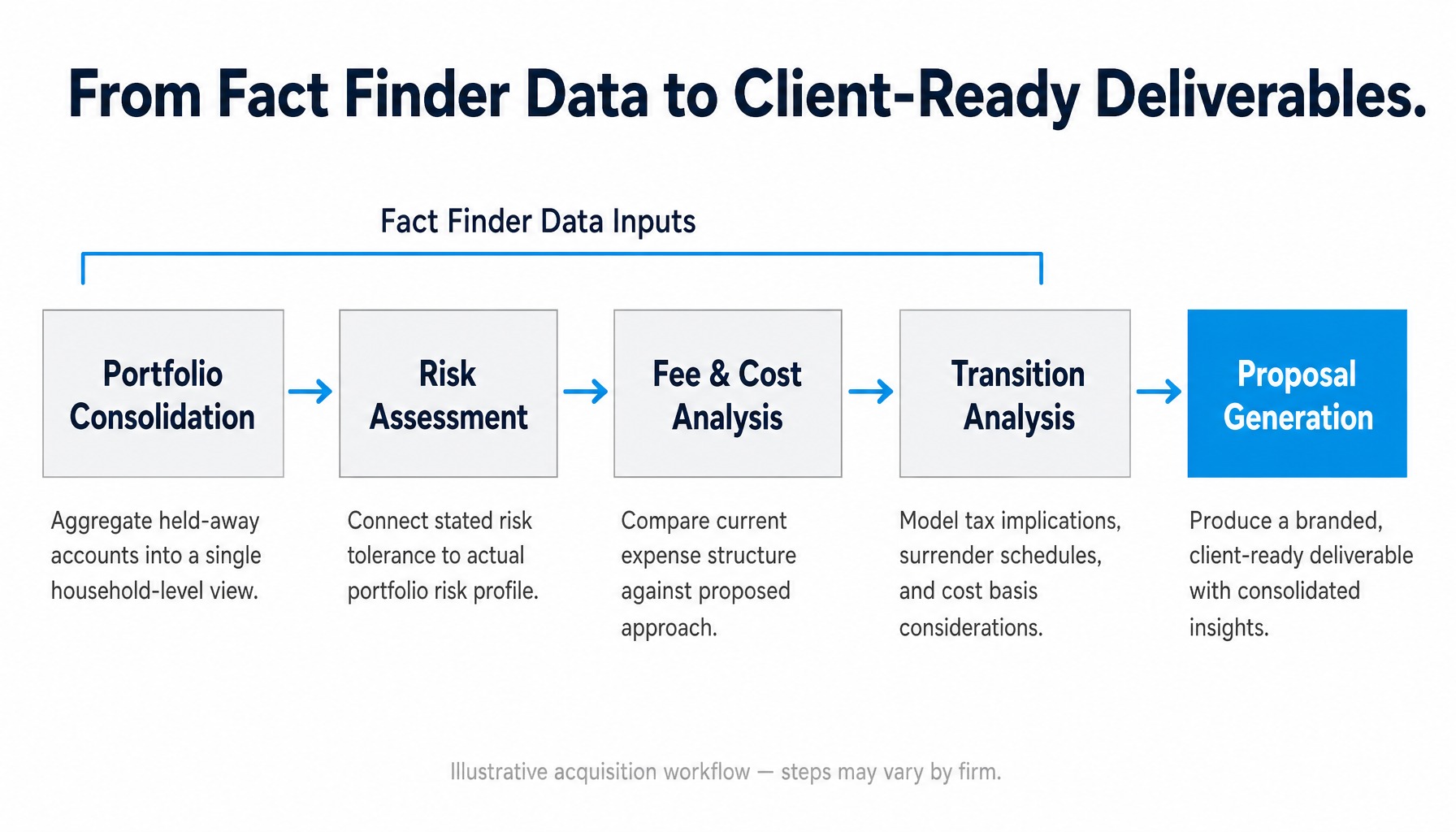
One approach is to reverse-engineer the fact finder's design from what the firm needs to produce downstream. If the proposal workflow requires cost basis data, the template can include a field to capture it. For advisors looking to scale a financial advice practice
, this kind of structured intake can help build capacity over time.
Connecting Fact Finder Data to Portfolio Insights and Client-Ready Deliverables
When a fact finder process surfaces a prospect's investment statements, the work of analysis, consolidation, and presentation is just beginning.
Moving through this stage consistently often starts with a repeatable acquisition workflow. The VRGL Growth Platform is a configurable system of work designed to support that workflow. Within it, VRGL Core is designed to organize holdings and related portfolio information for portfolio analysis and branded deliverables.
When the discovery process surfaces investment statements, VRGL's automated Statement Extraction can ingest those documents, structure the data, and help create a consolidated portfolio view. From there, the platform supports analytics across areas such as performance, risk, diversification, and fees, providing objective insights that inform an advisor's recommendation. For enterprise firms , VRGL is designed to support firmwide consistency across analytical workflows and presentation templates, helping keep the path from prospect data to client presentation repeatable across advisors and offices.
See how VRGL connects client data to your acquisition workflow
Conclusion
A financial planning fact finder template can be more than a data collection form or a compliance document. One useful measure of its value is whether the information it captures can flow into the firm's analytical and proposal workflows without creating manual, time-consuming handoffs.
The design of a template can be informed by what happens downstream portfolio consolidation, risk assessment, transition analysis, and the creation of client-ready deliverables. Firms that treat the fact finder as the first step in a repeatable acquisition workflow, rather than as a standalone artifact, can reduce the manual effort between discovery and presentation, allowing advisors to spend more time with clients and prospects.
Frequently Asked Questions
What is the difference between a fact finder and a full financial plan?
A fact finder is a data collection tool used during discovery to capture a prospect's financial position assets, liabilities, income, and goals. A financial plan is the analytical output that interprets that data to project outcomes. The fact finder provides the inputs for the plan; it does not replace it.
How often do advisory firms update their fact finder templates?
Firms may want to review their fact finder templates when their analytical workflow changes, when regulatory documentation expectations evolve, or when they begin serving client segments with different complexity levels.
Can a fact finder template help identify portfolio consolidation opportunities?
Yes, if the template is designed to capture held-away accounts and outside holdings with enough detail to build a consolidated view. A fact finder that only captures account balances without custodian or registration data limits an advisor's ability to identify consolidation opportunities during the initial engagement.
What risk tolerance and capacity questions belong in a fact finder?
A fact finder may capture information relevant to risk tolerance and capacity, such as time horizon, income needs, comfort with volatility, liquid assets, income stability, and liability obligations.
What are common challenges when transitioning from ad hoc discovery to a structured fact finder process?
One potential challenge is advisor adoption, particularly when a standardized template feels too rigid for individual discovery styles. Some firms address this by framing the fact finder as a minimum data standard rather than a conversation script. Other challenges include integrating the template with existing CRM workflows without manual re-entry.